


Why Your Home Needs a Central Humidifier
We spend a lot of thought on the temperature of our homes — the right thermostat, better insulation, a smarter AC. But there's a second number that shapes how comfortable a home feels, and most of us never look at it: humidity. When the air inside gets too dry, you feel it in your skin, your throat, your sleep — and your home feels it in its floors, doors and furniture. A central humidifier fixes that for the whole house, silently, every single day.
What is a central humidifier?
A central (or whole-house) humidifier is installed directly into your home's heating and air system. Instead of a small tank sitting on a bedside table, it adds a measured amount of moisture to the air as it moves through your ducts, so every room gets the same balanced humidity.
It's connected to your water supply and controlled by a humidistat — a thermostat for moisture. You set the level you want once, and the system takes care of the rest.
The problem with dry indoor air
Dry air is sneaky. It rarely announces itself, but the signs add up:
- Itchy, flaky skin and chapped lips that no amount of moisturiser seems to fix
- Waking up with a scratchy throat, dry eyes or a blocked nose
- Static shocks every time you touch a door handle or a family member
- Wooden floors developing gaps, doors that stop closing properly, furniture joints loosening
- Houseplants that struggle no matter how often you water them
Heating systems and air conditioners both pull moisture out of indoor air, which is why the problem is often worst in the very seasons we keep our homes closed up.
1. Better health and easier breathing
Your nose, throat and airways rely on a thin layer of moisture to trap dust, germs and allergens. When the air is too dry, that natural defence dries out with it. Keeping indoor humidity in a healthy range helps:
- Soothe your airways — less irritation, coughing and nosebleeds, especially for children and older family members
- Support your body's defences — research suggests many airborne viruses, including flu, survive and spread more easily in dry air
- Improve sleep — fewer nights of waking up parched, congested or snoring
- Care for your skin — balanced humidity helps skin hold onto its own moisture
2. Protection for your home and belongings
Your home is full of materials that react to moisture. Wood shrinks when it dries out and swells when it
absorbs water. When humidity swings wildly, things crack, warp and loosen.
A central humidifier helps protect:
- Hardwood floors, wooden doors and window frames
- Furniture, cabinets and antiques
- Musical instruments like pianos, guitars and violins, which can go out of tune or crack in dry air
- Artwork, books and documents
- Electronics, which are more vulnerable to static discharge
Think of it as insurance for the things you've invested in — and the things you can't replace.
3. A warmer feel and lower energy bills
Here's the part that surprises most people: humid air feels warmer than dry air at the same temperature. Dry air pulls moisture off your skin, and that evaporation makes you feel cold.
With balanced humidity, many households find they're comfortable with the thermostat set a little lower. Over a full heating season, that small adjustment can add up to real savings — and a smaller carbon footprint.
4. Whole-house comfort with almost zero effort
Portable humidifiers help one room at a time, and they come with chores: refilling tanks daily, cleaning out slime and mineral build-up, and moving units from room to room. A central humidifier changes that:
- Every room is covered — bedrooms, living spaces, the home office, all at once
- No refilling — it draws water directly from your supply
- Automatic control — the humidistat keeps levels steady day and night
- Quiet and invisible — no humming units or cords cluttering your rooms
- Low maintenance — usually just a filter or pad change once or twice a year
Types of central humidifiers
|
Type |
How it works |
Best for |
|
Bypass |
Uses the furnace's own airflow to push air over a water panel |
Smaller homes and budget-conscious buyers |
|
Fan-powered |
Has its own fan to move more air across the water panel |
Medium to large homes that need more output |
|
Steam |
Boils water to produce clean steam injected into the ducts |
Large homes, very dry climates and the most precise control |
A local HVAC professional can recommend the right type and size for your home, climate and existing system.
Finding the right level: not too dry, not too damp
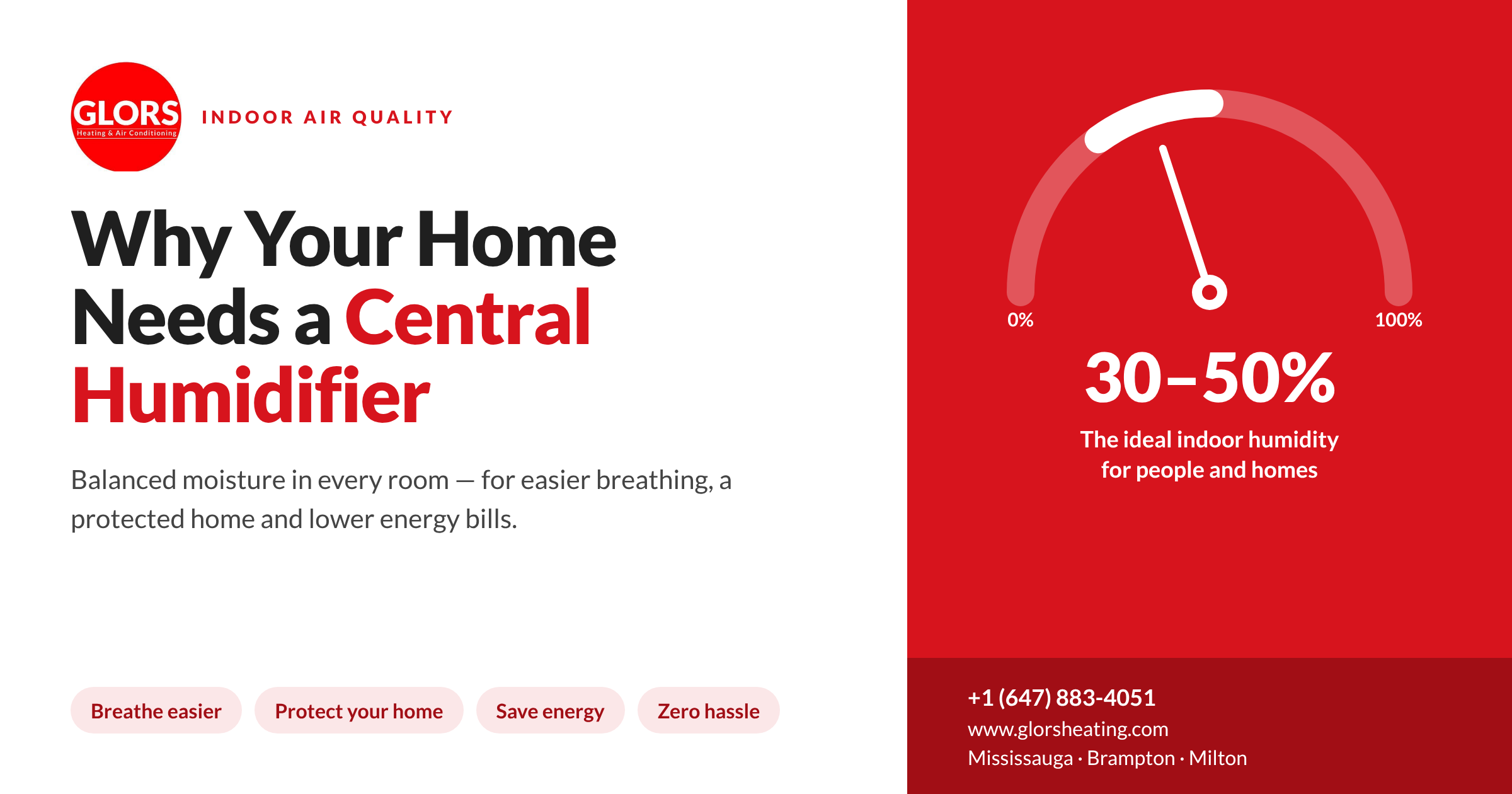
More humidity isn't always better. The commonly recommended range for indoor air is roughly 30% to 50% relative humidity.
- Below 30% — dry skin, irritated airways, static and shrinking wood
- 30–50% — the comfort zone for people and homes
- Above 50–60% — condensation on windows, and a risk of mould, mildew and dust mites
This is exactly why a central system shines: its humidistat holds the level steady instead of overshooting the way a forgotten portable unit can.
Signs it's time to consider one
- You run portable humidifiers in several rooms and are tired of refilling them
- Static shocks are a daily event
- Your wooden floors or furniture are cracking or separating
- Family members often wake up congested or with sore throats
- You feel chilly indoors even when the thermostat says it's warm
Simple maintenance tips
- Replace the water panel or filter as recommended — typically once or twice a year
- Check the humidistat setting as the seasons change
- Have it inspected along with your regular HVAC service
- Watch for condensation on windows — if you see it often, lower the setting
